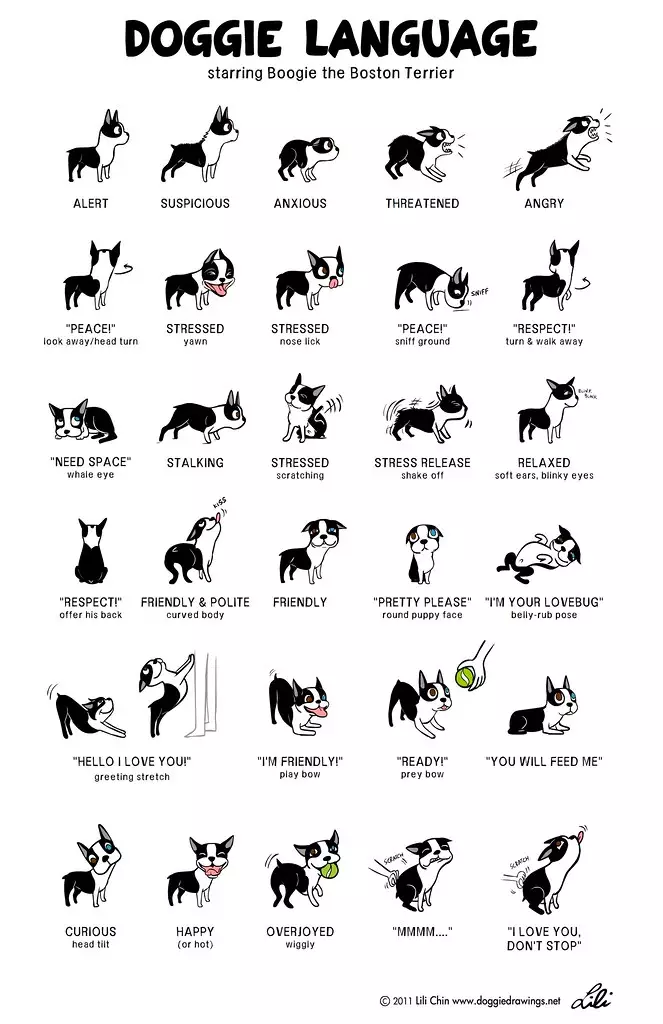
- Tail held high: Usually indicates confidence or joy.
- Drooping Tail: Can be a sign of insecurity, sadness or submission.
- Tail wagging: Excitement or joy.
- Raised ears: This means the dog is attentive or excited.
- Drooping ears: May indicate fear or submission.
- Forward-tilted ears: May indicate interest or friendliness.
- Direct gaze: Expresses confidence or dominance.
- Averting your eyes: Can be a sign of submission or fear.
- Blinking: May indicate trust and friendliness.
- Open muzzle: A sign of trust and friendliness.
- Pursed lips: May indicate tension or dissatisfaction.
- Excited breathing: Can be a sign of excitement or fear.
- Straight back: Confidence and readiness for action.
- Bowing of the body: May indicate submission or a call to play.
- Whole body swinging: Excitement and joy.
- Tail between legs: May indicate fear or submission.
- Ears back: Submission or fear.
- Tail held high and vibrating: Often when meeting a new person or another dog.
- Following commands: Obedience and trust.
- Licking: Can be a sign of caring and friendliness.
- Paw Giving: A request for attention or friendliness.
Abstract:
This extensive exploration delves into the intricate world of dog body language, seeking to decipher the rich tapestry of signals and expressions that dogs use to communicate with humans and other animals. Drawing on scientific research, behavioral studies, and the observations of experienced dog trainers and enthusiasts, this guide aims to unravel the fascinating nuances of canine communication. Understanding dog body language not only enhances the bond between humans and their canine companions but also contributes to safer and more enriching interactions with dogs.
1. Introduction: The Silent Symphony of Canine Communication
1.1 The Importance of Understanding Dog Body Language:
Dogs, as highly social and expressive animals, rely heavily on body language to convey their emotions, intentions, and reactions. This introduction sets the stage for exploring the multifaceted world of dog body language, emphasizing the significance of interpreting canine signals for fostering positive interactions.
1.2 Communication Beyond Barks:
While barking is one aspect of canine communication, the richness of dog language extends far beyond vocalizations. This section introduces the idea that understanding the silent cues embedded in dog body language is essential for grasping the true depth of canine expression.
2. Canine Facial Expressions: Windows to the Canine Soul
2.1 The Language of Ears:
Dog ears are dynamic indicators of a dog's mood and emotions. This section explores the various ear positions and movements, drawing on studies such as those by Reisner et al. (2007), to decode the silent messages communicated through this essential feature of canine anatomy.
2.2 Eyes: Mirrors Reflecting Canine Emotions:
A dog's eyes are powerful conveyors of emotions, revealing joy, fear, curiosity, and more. Scientific research, including studies by Kaminski et al. (2017), guides us through the nuances of canine eye expressions and the role they play in communication.
2.3 Mouth and Lips: Unveiling Canine Intentions:
Dog mouths and lips play a crucial role in expressing a range of emotions, from fun to stress. This section explores the language of canine mouths, citing studies such as those by Huber et al. (2018), to unravel the messages conveyed through lip licks, yawning, and other mouth movements.
2.4 The Role of Facial Muscles: Microexpressions in Dogs:
Microexpressions, subtle facial movements that occur in fractions of a second, provide insights into a dog's instantaneous emotional responses. Drawing on studies in human psychology and adapting them to canine behavior, this section explores the potential existence and significance of microexpressions in dogs.
3. Canine Postures: The Artistry of Canine Communication
3.1 The Stance: Confidence, Submission, and Anxiety:
A dog's overall stance communicates volumes about its confidence, submission, or anxiety levels. This section delves into the meanings behind various body postures, citing studies such as those by Overall (2013), to unravel the silent language of a dog's physical presence.
3.2 Tail Talk: Expressive Movements from Wagging to Tucked:
A dog's tail is a versatile tool for expressing emotions and intentions. Scientific research, including studies by Quaranta et al. (2007), guides us through the different tail positions and movements, demystifying the tongue behind the wagging, tucking, and stiffness of a dog's tail.
3.3 The Language of Paws: Gestures and Postures:
A dog's paws are not just functional; they are also instrumental in conveying emotions and intentions. This section explores the subtle gestures and postures involving a dog's paws, referencing studies on canine behavior, such as those by Beerda et al. (1998), to unveil the silent communication encoded in paw movements.
3.4 Rolling, Stretching, and Other Full-Body Expressions:
Beyond individual body parts, a dog's full-body expressions provide additional layers of communication. Studies on canine body language, including research by Smith and Litchfield (2010), guide us through the meanings behind behaviors such as rolling, stretching, and other full-body movements.
4. Vocalizations and Canine Language: Barks, Howls, and Beyond
4.1 Decoding Barks: Different Tones, Different Messages:
While barking is a familiar aspect of canine communication, the tone, pitch, and rhythm of barks convey nuanced information. This section explores the variations in barking and how studies on canine vocalizations, such as those by Faragó et al. (2010), contribute to understanding the different meanings behind the bars.
4.2 The Enigma of Howling: Expressing Emotion and Connection:
Howling is a distinctive vocalization with a variety of meanings. Drawing on studies by Yin (2002) and other canine behavior experts, this section explores the emotional and social aspects of howling, shedding light on why dogs engage in this unique form of vocal expression.
4.3 Whining, Growling, and Grumbling: Subtle Vocal Cues:
Beyond barks and howls, dogs employ a range of subtle vocalizations such as whining, growling, and grumbling. Referencing studies on canine vocal communication, including research by Yin (2015), this section decodes the meanings behind these nuanced sounds and their role in canine language.
5. The Influence of Breed and Individual Variation in Canine Language
5.1 Breed-Specific Body Language: Understanding Diversity:
Different dog breeds may exhibit variations in body language, influenced by their genetics, historical roles, and physical characteristics. This section explores breed-specific expressions, referencing studies on breed behaviors, to highlight the importance of recognizing and appreciating these differences.
5.2 Individual Variations: The Unique Canine Personality:
Just as humans have individual personalities, dogs also exhibit unique variations in behavior. Drawing on studies in canine psychology, including research by Jones and Gosling (2005), this section explores how individual differences contribute to the richness of canine communication.
5.3 The Influence of Early Experiences: Socialization and Canine Language:
Early experiences, particularly during the critical socialization period, shape a dog's communication skills. This section delves into the impact of early experiences on canine body language, citing studies on puppy socialization, to emphasize the role of positive interactions in shaping a dog's social behavior.
6. The Dynamics of Canine Social Interactions: From Pack Behavior to Family Dynamics
6.1 Pack Dynamics: The Legacy of Wolves in Dog Communication:
Dogs, descendants of wolves, retain some pack dynamics in their social interactions. Scientific studies on wolf behavior, such as those by Mech (1999), guide us through the legacy of pack dynamics and their influence on canine communication in group settings.
6.2 Dog-Human Interactions: Bridging the Communication Gap:
As dogs have become integral members of human families, understanding the dynamics of dog-human interactions is crucial. This section explores studies on the human-dog bond, including research by Topál et al. (1998), to unravel how dogs adapt their communication to connect with their human counterparts.
6.3 Canine Play: Expressing Joy, Bonding, and Social Skills:
Play is a vital aspect of canine communication, serving multiple purposes such as expressing joy, bonding with others, and honing social skills. This section references studies on canine play behavior, including research by Rooney et al. (2000), to explore the intricacies of play as a form of communication.
7. Challenges in Interpreting Canine Body Language: Cultural Variations and Individual Contexts
7.1 Cultural Variations in Interpreting Canine Signals:
Cultural perspectives can influence how individuals interpret and respond to canine body language. This section explores cultural variations in canine communication, citing studies on cultural differences in dog-human interactions, to highlight the need for cross-cultural understanding.
7.2 Individual Contexts: The Influence of Surroundings and History:
A dog's behavior is not static; it can be influenced by the immediate surroundings and individual history. Drawing on studies on canine behavior modification, including research by Overall (1997), this section explores the dynamic nature of canine communication in various contexts.
7.3 The Impact of Stress and Anxiety on Canine Body Language:
Stress and anxiety can significantly alter a dog's body language, complicating the interpretation of signals. Studies on canine stress indicators, including research by Beerda et al. (1998), guide us through the physical and behavioral manifestations of stress and their implications for interpreting canine communication.
8. Training and Enhancing Canine Communication: A Two-Way Street
8.1 Canine Communication in Training: Building Trust and Understanding:
Understanding canine body language is integral to effective dog training. This section explores studies on positive reinforcement training, including research by Yin (2007), to emphasize the role of clear communication, trust-building, and the use of body language cues in training sessions.
8.2 Enhancing Canine Communication Through Human Education:
Educating humans about canine body language is equally important for fostering positive interactions. Drawing on studies in dog-human communication education, including research by Jakovcevic et al. (2013), this section explores the impact of human knowledge on interpreting and responding to canine signals.
8.3 The Canine-Human Bond: Nurturing Through Mutual Understanding:
A strong bond between dogs and their human companions is rooted in mutual understanding and effective communication. This section delves into studies on the human-canine bond, including research by Prato-Previde et al. (2003), to highlight the reciprocal nature of communication that enhances the bond between dogs and humans.
9. Health and Canine Communication: The Link Between Physical and Emotional Well-being
9.1 Physical Health Indicators in Canine Body Language:
Changes in a dog's physical health can manifest through alterations in body language. This section explores studies on physical health indicators in canine behavior, including research by McGreevy et al. (2012), to provide insights into recognizing signs of discomfort or illness through body language.
9.2 The Role of Mental Well-being in Canine Communication:
Mental well-being is closely tied to a dog's ability to communicate effectively. Drawing on studies on canine mental health, including research by Blackwell et al. (2013), this section explores the interplay between emotional well-being and the expression of canine body language.
9.3 The Impact of Aging on Canine Communication:
As dogs age, their communication patterns may undergo changes. Studies on geriatric canine behavior, including research by Neilson et al. (2001), guide us through the impact of aging on canine communication and the importance of adapting interactions to the changing needs of senior dogs.
10. Canine Communication in Different Life Stages: From Puppies to Seniors
10.1 Puppyhood: Early Socialization and Communication Skills:
Puppies undergo critical periods of socialization that shape their communication skills. This section explores studies on puppy development, including research by Scott and Fuller (1965), to elucidate the role of early experiences in laying the foundation for effective canine communication.
10.2 Adolescence: Challenges and Transformations in Canine Communication:
Adolescent dogs experience transformations in behavior and communication as they transition to adulthood. Drawing on studies on canine adolescence, including research by Neilson et al. (1997), this section explores the challenges and unique aspects of canine communication during this life stage.
10.3 Adulthood: The Prime of Canine Communication:
Adult dogs exhibit refined communication skills that reflect their maturity and life experiences. Studies on adult canine behavior, including research by Rooney et al. (2007), provide insights into the nuanced expressions and social interactions of dogs in their prime.
10.4 Senior Years: Adapting Communication to Changing Needs:
Senior dogs may adapt their communication patterns to cope with physical and cognitive changes. Drawing on studies on geriatric canine behavior, including research by Duffy et al. (2018), this section explores the ways in which senior dogs express themselves and the importance of understanding and adapting to their changing communication needs.
11. The Future of Canine Communication Research: Emerging Trends and Areas for Exploration
11.1 Advancements in Canine Cognitive Research: Unlocking the Canine Mind:
Emerging trends in canine cognitive research offer exciting opportunities to delve deeper into the workings of the canine mind. This section explores recent studies on canine cognition, including research by Fugazza et al. (2016), to highlight the potential for unlocking new dimensions in our understanding of canine communication.
11.2 Technological Innovations in Studying Canine Behavior:
Technological advancements, from wearable devices to advanced imaging techniques, are transforming the field of canine behavior research. This section explores studies on technological innovations in canine behavior research, including research by Wallis et al. (2019), to showcase how these tools contribute to a more nuanced understanding of canine communication.
11.3 Cross-Species Communication Studies: Bridging the Gap Between Dogs and Humans:
Cross-species communication studies aim to bridge the gap between humans and dogs, unraveling the intricacies of interspecies communication. This section explores research on cross-species communication, including studies by Hare and Tomasello (1999), to shed light on the evolving field of understanding how dogs and humans communicate with each other.
12.Conclusion: Nurturing the Canine Connection Through Understanding and Respect
12.1 Celebrating the Diversity of Canine Communication:
The canine language of body expressions is a rich tapestry of signals and cues, reflecting the diversity of dog personalities, breeds, and life stages. This concluding section celebrates the complexity and beauty of canine communication, emphasizing the need to appreciate and respect the individuality of each dog.
12.2 Fostering Positive Canine-Human Relationships:
Understanding and respecting canine body language is fundamental for fostering positive relationships between dogs and humans. This guide concludes by highlighting the role of mutual understanding, effective communication, and respect in nurturing the bonds that make the canine-human relationship a source of joy, companionship, and mutual enrichment.
In conclusion, this comprehensive exploration of dog body language aims to provide readers with a deep understanding of the silent communication encoded in the gestures, postures, and vocalizations of dogs. By delving into scientific research, behavioral studies, and real-world observations, this guide celebrates the intricate world of canine communication and serves as a valuable resource for dog owners, trainers, enthusiasts, and anyone interested
Comments
Post a Comment